This Desert Prince Whose Soul May Never Fit in Your Suburban Backyard
- Quick Tags: Azawakh, desert sighthound, high-endurance dog breed
- Editor: Chloe Jones
- Updated: Mar,26,2026
- Views: 284.6k






My friend Javi’s Instagram used to be a feed of sleek fashion shots and city sunsets—until he met an Azawakh at a breed expo. He was hooked instantly: that supermodel-thin frame, ears like elegant pennants, and a gaze that felt like it carried the weight of the Sahara. He named his new pup Kai, posting reels of the dog’s statuesque silhouette against his Brooklyn apartment skyline, and quickly amassed comments like “Most stylish dog ever!” Six weeks later, the reels vanished. “I thought I was getting a cool, low-key companion,” Javi admitted, watching Kai pace relentlessly by the window, tail tucked. “Turns out, I’ve got a desert ghost stuck in a 700-square-foot box—and he’s screaming to get out, even if he never barks.” That’s the unvarnished truth about Azawakhs: they’re not city accessories or Instagram props. They’re creatures forged in sand and wind, built for endless miles and open skies, and forcing them into suburban backyards or urban apartments raises not just practical hurdles, but big ethical questions about what it means to “own” a wild-at-heart breed.
Let’s start with their roots: For millennia, the Tuareg people of the Sahara have bred Azawakhs as sighthounds and guardians, shaping them to survive extreme heat (temperatures up to 120°F) and cover 30+ miles a day chasing prey. Their ultra-lean bodies—ribs visible, muscles taut—aren’t a sign of neglect; they’re a survival adaptation, maximizing heat dissipation. Their short coats and large ears act like built-in AC, while their paws are tough enough for scorching sand. But that desert DNA comes with trade-offs: they shiver in temps below 50°F, and loud, sudden city noises—sirens, garbage trucks, construction—trigger their fight-or-flight response. “Kai hides under the couch for hours after a fire truck passes,” Javi says. Canine behavior studies back this up: Sighthounds like Azawakhs have 2x more sensitive hearing than retrievers, making urban chaos a constant stressor.
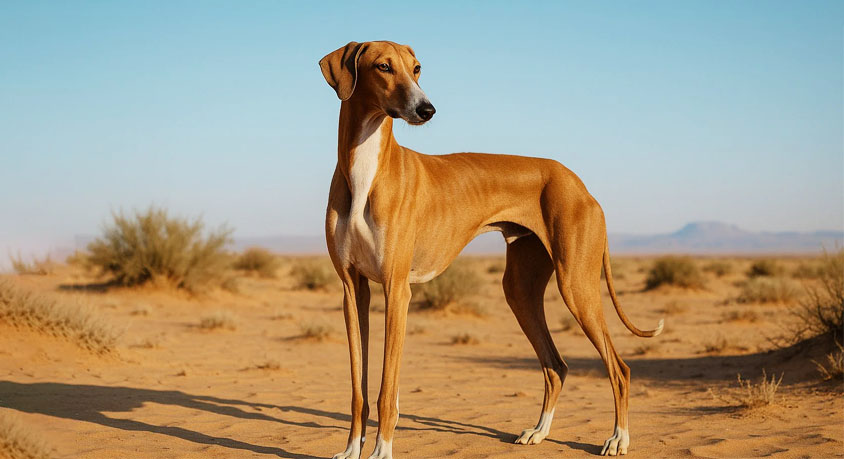
Personality-wise, Azawakhs are introverts with a loyal streak. They don’t slobber or beg for pets; they bond deeply with their owners but show love through quiet presence—curling up beside you only after a long run, or following you from room to room without a sound. “He’s not unfriendly,” Javi laughs. “He’s just… selective. Like a friend who only hangs out if you’re doing something worthwhile.” But that reserve turns to anxiety in confinement. When Javi works 10-hour days, Kai chews doorframes and howls softly—a far cry from his calm desert heritage. The Azawakh Club of America warns that these dogs need “stimulation that mirrors their wild role”: not casual walks, but structured runs, lure coursing, or scent work to satisfy their prey drive. Javi tried neighborhood walks, but Kai pulled so hard he nearly dislocated Javi’s shoulder, fixated on squirrels like they were Sahara gazelles.
The core issue is ethical: Is it fair to trap a breed engineered for boundless space in a world of concrete and leashes? Javi learned this the hard way. He started waking at 5 a.m. to run Kai 10 miles before work, bought a cooling mat for summer, and even got noise-canceling wraps for storms. Slowly, Kai relaxed—less pacing, more napping by the window (though he still stares longingly at the horizon). But Javi admits it’s a full-time commitment. “I didn’t just get a dog; I signed up to be a desert dog’s translator in a city that doesn’t speak his language,” he says. A 2024 Sighthound Welfare League survey found 65% of urban Azawakh owners report stress signs (pacing, chewing, anxiety) versus 20% in rural, open-space homes.
Azawakhs aren’t bad dogs—they’re misplaced ones. Their beauty is undeniable, their loyalty fierce, but their needs are non-negotiable. They’re not for apartment dwellers, busy professionals, or anyone who thinks “a walk a day” cuts it. They need owners with the time, space, and respect to let them be the desert souls they are. Javi’s reels are back now, but they’re not just aesthetic shots—they’re videos of Kai sprinting across a rural trail, ears flapping, a rare, unguarded joy on his face. “He’s happy now, but only because I stopped trying to make him fit my life,” Javi says.
If you’re drawn to the Azawakh’s ghostly grace, admire them—from afar. Before bringing one home, ask: Can I give this desert prince the wind in his fur and endless miles he was born for? Or am I just buying a pretty accessory? The Azawakh deserves more than a life as a prisoner in a concrete jungle. He deserves the Sahara in his veins—and if you can’t give him that, he’s not the dog for you.